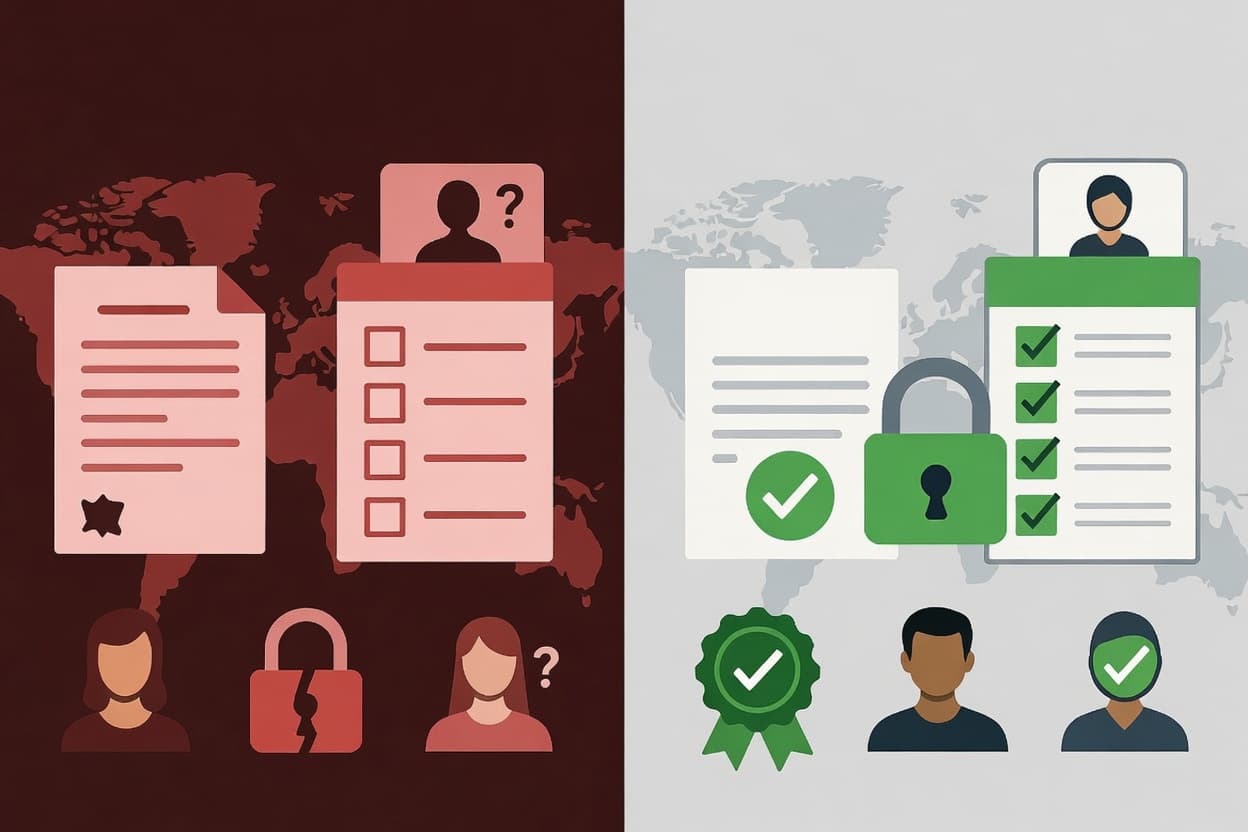
How to show an overseas employer you can be trusted to deliver
If I've learned anything these past eight years working from my Manila apartment for companies across three continents, it's that trust isn't given - it's built, brick by painstaking brick.
Back in 2021, when most companies were still figuring out if remote work could even function long-term, trust was the elephant in every Zoom room. Now in 2026, with distributed teams being standard practice, you'd think we'd have cracked the trust code.
We haven't. Not completely.
I spoke with hiring managers at UK firms last month, and their concerns haven't changed much: "How do I know they're actually working?" "Will they disappear once we've invested in training them?" "Can they deliver without constant supervision?"
So if you're looking to land a job with an employer thousands of miles away, here's what actually works - not the generic "communicate well" advice, but specific, tested approaches to becoming someone your distant boss would fight to keep.
The pre-interview trust foundation
Trust building starts long before you're hired. Your digital presence tells a story, and potential employers are absolutely reading it.
Last week I worked with a senior full-stack developer in Jakarta whose technical chops were outstanding, but whose GitHub activity looked like a ghost town with sporadic commit spikes. To a distant UK hiring manager who can't meet him in person, that pattern looked like an unpredictable contractor who delivers in erratic bursts. We restructured how he published his open-source work and side projects to demonstrate steady, predictable velocity.
The takeaway applies across every role: your digital footprint is your resume's trust index. Designers should showcase Figma iteration logs; product managers should share sanitized Notion spec sheets; writers should maintain a verifiable publishing cadence. In cross-border hiring, visible artifacts beat verbal promises every single time.
But there's something even more fundamental at play.
The response-time multiplier
Here's something recruiters almost never tell candidates: in remote hiring, your communication tempo during the application process is seen as a prediction of your work tempo.
If you take 48 hours to respond to interview scheduling emails, employers unconsciously file that information away as "this person will be slow to respond when we need them."
I've tracked this across hundreds of placements. Candidates who respond within 3-4 hours to communications during the hiring process are 3x more likely to make it to final rounds than those who consistently take a day or more.
This doesn't mean becoming a slave to your inbox. It means creating systems that allow for prompt responses during critical evaluation periods. When someone is deciding whether to trust you with a job, your responsiveness isn't just courtesy - it's a performance metric.

Beyond Tick Boxes: Diversity Recruitment Strategies That Actually Transform UK Workplaces

Master the Virtual Hot Seat: 7 Video Interview Techniques Recruiters Don't Tell You

How to Master 'Tell Me About Yourself' Interview Question: UK Expert Insights
What separates survivors from casualties
I've watched plenty of remote arrangements implode. The pattern is remarkably consistent.
Remote workers who last typically share these traits:
- They deliver something meaningful before they're asked
- They communicate problems before they're discovered
- They build relationships beyond their direct reporting lines
That first point deserves elaboration. "Work ahead" sounds like generic advice, but there's nuance in how you apply it. The most successful remote professionals I know practice what I call "micro-deliveries" - sending small, useful work products between formal deadlines.
This isn't about overworking. It's about visibility.
When your manager gets a message saying, "I noticed X might help with the project, so I put together this quick analysis," they receive both the work product AND confirmation that you're thinking proactively. That builds exponentially more trust than simply hitting deadlines.
The problem with problem-solving
Here's where many remote workers go wrong: they hide problems, thinking independence means solving everything themselves.
I made this mistake myself back in early 2024. A client's scope changed dramatically mid-project, and rather than flagging it immediately, I spent three days trying to reconfigure the entire approach solo. By the time I brought it up, I was already behind, and the client was irritated I hadn't mentioned it sooner.
The lesson?
Independence isn't solving every problem alone. It's knowing which problems need collaborative solutions and bringing them forward early, with potential paths forward already identified.
Trust at the cultural crossroads
Cultural factors deeply shape how trust is evaluated across borders. In high-context workplace cultures like the Philippines, team members often default to politeness and harmony (Pakikisama), saying "yes" to maintain goodwill even when requirements are unclear or timelines are unrealistic. Meanwhile, low-context UK managers expect immediate, direct pushback when something is unfeasible. When those two norms collide, silence or polite nod-alongs get misread as incompetence or unreliability.
The solution is constructive transparency: bridging the gap by pairing pushback with actionable alternatives. Replacing an anxious "Yes, boss" with "This timeline will be tight due to X, but I can deliver milestone Y by Friday if we deprioritise Z" bridges the cultural gap and builds trust instantly.
Trust metrics you should track (but probably don't)
The most indispensable remote talent operates against an unspoken Personal SLA (Service Level Agreement):
- Response Predictability: Employers want to know if they can count on hearing back from you during your core hours. You can demonstrate this by setting predictable daily update windows rather than relying on sporadic messaging.
- Say-to-Do Ratio: Employers are watching to see if things actually get done when you casually mention, "I'll look into that." You can demonstrate this by logging every verbal commitment into a personal tracker before leaving a meeting.
- Doc Output Ratio: Employers want to see if you are leaving behind readable artifacts or keeping knowledge to yourself. You can demonstrate this by converting every solved issue into a shared wiki entry or team document.
That middle metric is particularly critical. Many professionals make casual commitments in meetings ("I'll look into that") without tracking them. Each unfulfilled promise, no matter how small, erodes trust.
I keep a simple system - every promise made gets logged immediately, and I review this log daily. It's not about creating pressure, but about honoring commitments reliably enough that trust becomes automatic.
Build multipliers, not just delivery
The strongest remote trust isn't built on reliability alone. It comes from becoming a multiplier - someone who makes others more effective.
Look, anyone can deliver their assigned work. The professionals who become indispensable are those who help others deliver better too.
This doesn't require formal leadership roles. It can be as simple as documenting solutions to problems you've solved, creating templates others can use, or connecting team members who could help each other.
For instance, I noticed our London team was struggling with a particular client reporting format. Rather than just handling my own reports correctly, I created a template with embedded examples and shared it. Six months later, I learned they were still using it with new team members.
That single contribution did more for my perceived value than months of meeting my regular deliverables.
The harsh reality of remote trust
Here's something nobody tells you: remote trust is fundamentally fragile. One significant miss can undo months of careful building.
I've seen professionals with stellar track records suddenly find themselves under microscopic supervision after a single high-profile mistake. The distance amplifies concerns.
This isn't meant to create anxiety, but to emphasize reality. Remote trust requires constant reinforcement. It's never "earned" permanently.
So what do you do? Create systems that make failure nearly impossible. Use redundant reminders, build buffer time into every estimate, and create personal check processes for high-stakes deliverables.
Making distance irrelevant
The most trusted remote professionals don't just overcome distance - they make it irrelevant.
I've worked with people who feel more present from 5,000 miles away than colleagues I've shared physical offices with. They achieve this through a combination of predictable availability, proactive updates, and consistency that borders on the remarkable.
They understand that trust isn't built through grand gestures, but through the accumulation of small promises kept. Every email answered, every deadline hit, every problem flagged early adds another tiny deposit in the trust account.
And they recognize that physical distance creates not just logistical challenges but psychological ones. So they find ways to bridge the human gap - sharing occasional personal context, acknowledging time zone sacrifices, expressing genuine interest in their colleagues' success.
In my experience, building remote trust isn't fundamentally about tools or techniques. It's about showing up - consistently, thoughtfully, and with an awareness of what your distant colleagues need most: the confidence that when they rely on you, their trust is well-placed.
Because at its core, that's what all employers are buying when they hire remotely: the profound relief of knowing that despite the distance, their work is in capable, committed hands.
Marco Santos helps professionals across Southeast Asia land and thrive in international remote roles. Find more practical remote career guidance on The OHub's insights hub.