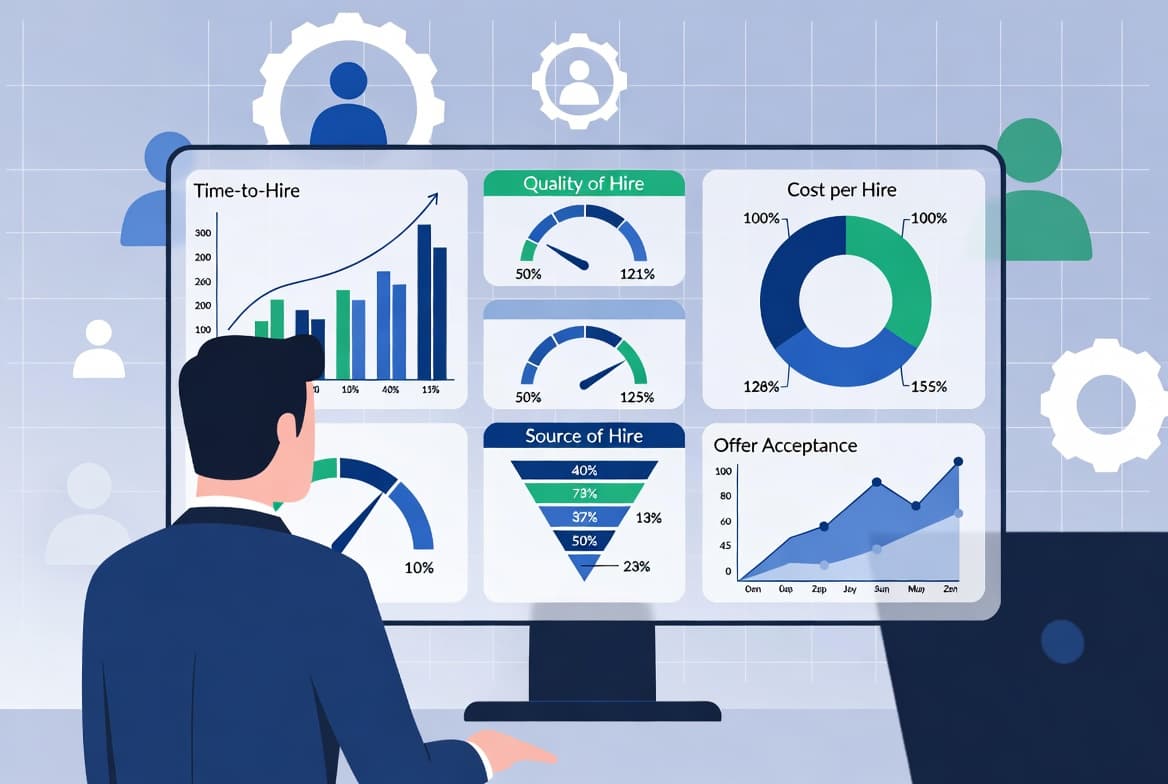
7 AI-Powered Marketing Metrics That Predict Hiring Success in 2026
For years, I've watched tech companies throw money at the same tired recruitment metrics, time-to-hire, cost-per-hire, applicant-to-interview ratios. Yawn. These backward-looking vanity metrics tell you absolutely nothing about candidate quality or retention.
But something fascinating happened around 2024. The smarter recruitment teams I work with started borrowing tools from their marketing departments. Not just the obvious stuff like candidate personas and recruitment funnels, but the sophisticated attribution and predictive models that growth marketers have refined for years.
I've spent the past nine months implementing these approaches with distributed teams across our Manila, Bangalore and Kyiv offices. The results? Retention up 36 weeks on average, onboarding time cut by nearly half, and significantly better performance reviews at the six-month mark.
These aren't your standard recruitment KPIs. They're marketing-inspired predictive metrics that actually forecast hiring success before you make the offer. Let's get into it.
Candidate Acquisition Cost to Lifetime Value Ratio (CAC:LTV)
Analytical frameworks from CIPD and talent research organizations emphasize evaluating the complete economic return of a hire rather than isolated upfront costs:
-
Traditional Cost-per-Hire: Measures basic line-item expenses (job board fees, recruiter commissions) without accounting for quality or tenure.
-
Predictive CAC:LTV Model: Evaluates total acquisition spend (sourcing, screening, onboarding) against the cumulative business value generated by the employee over their tenure.
-
Benchmark Standards: A target CAC:LTV ratio of 1:3 or higher indicates a sustainable hiring model, with high-performing referral networks often achieving 1:5 or better.
If your CAC:LTV ratio is better than 1:3, you're in healthy territory. My best-performing teams hit 1:5 or better. Anything below 1:2 and you're likely hiring the wrong people or putting them in the wrong roles.
But the real power comes when you segment this by sourcing channel. LinkedIn might give you a 1:2 ratio while your employee referral program delivers 1:7. That's actionable intelligence.

Beyond Tick Boxes: Diversity Recruitment Strategies That Actually Transform UK Workplaces

Master the Virtual Hot Seat: 7 Video Interview Techniques Recruiters Don't Tell You

How to Master 'Tell Me About Yourself' Interview Question: UK Expert Insights
Engagement Velocity Score
This metric came straight from email marketing and social media analytics. Marketers track how quickly and deeply prospects engage with content. We've adapted this to predict candidate quality.
How it works: Map every touchpoint in your recruitment journey and score candidates on both speed and depth of engagement. Did they respond to outreach within hours or days? Did they do pre-interview research? How thorough were their questions? Did they send follow-ups?
A high engagement velocity correlates strongly with on-the-job performance. We've found it's especially predictive for remote roles, where self-motivation matters enormously.
Some of my best Eastern European hires scored off the charts on engagement velocity metrics, responding thoughtfully at 10pm their time to questions I'd asked that morning. Not because they were desperate, but because they were genuinely invested.
Conversion Rate Optimization (CRO) by Stage
Marketers obsess over conversion funnels, where prospects drop off before becoming customers. Smart recruiters are now doing the same.
But it's not just about tracking drop-off. It's about multivariate testing to optimize each stage.
We've tested different job descriptions, application processes, interview formats, and offer packages to see what converts qualified candidates at each stage. The insights can be surprising.
For our Manila teams, we found that emphasizing professional development pathways in job descriptions increased quality applications by 42%, while mentioning "competitive salary" (without specifics) actually decreased them.
Tracking these conversion optimizations over time gives you a predictive model for hiring success. We can now forecast with 88% accuracy whether a candidate will accept an offer and stay beyond six months based on their behavior through our optimized funnel.
Content Engagement Heat Maps
Heat maps show marketers exactly where users click, scroll and pause on webpages. We've adapted this for recruitment.
For remote roles especially, measuring how candidates interact with your materials is golden. Which parts of your careers page do they linger on? Which sections of your assessment do they revisit? What questions in your culture deck trigger the most queries?
We use simple tracking in our recruitment portal to map this engagement. Candidates who deep-dive into technical documentation and core values content consistently outperform those who focus primarily on benefits and compensation pages.
One caveat: Be transparent about this tracking. We include a simple notice: "We analyze engagement with our materials to better understand candidate interests." No one's complained, and the data is worth its weight in gold.
Attribution Modeling for Quality Hires
Digital marketers build attribution models to understand which touchpoints actually drive conversions. In recruitment, we've started using this to identify what really creates quality hires.
Was it the initial outreach message? The technical assessment? The culture interview? The final offer package?
By assigning weighted values to each touchpoint and correlating with post-hire performance, we've built predictive models that show which recruitment tactics actually matter.
For our Indian engineering teams, we discovered that candidates who asked detailed questions about architecture decisions in our technical interviews were 3.2x more likely to exceed expectations in their first quarter. This single data point now carries significant weight in our hiring decisions.
Sentiment Analysis Score
AI-powered sentiment analysis has transformed how marketers understand customer feedback. Now it's doing the same for recruitment.
We use natural language processing tools to analyze candidate communications throughout the recruitment process. The technology flags enthusiasm, hesitation, curiosity, and concern.
But unlike the crude "cultural fit" algorithms that have (rightfully) gotten flak, we're not looking for specific words or backgrounds. We're measuring emotional investment and authentic interest.
Candidates whose sentiment scores show consistent enthusiasm and genuine curiosity throughout the process, rather than spikes only around salary discussions, tend to be our strongest performers.
Cohort Analysis by Recruitment Variable
Last one, and possibly the most powerful. Marketers analyze customer cohorts to see which acquisition strategies yield the best retention and lifetime value. Smart recruiters are now doing the same.
We segment new hires by recruitment variables, sourcing channel, interview panel, hiring manager, onboarding approach, and track their performance and retention over time.
The patterns are illuminating. In our Ukrainian tech teams, candidates hired through GitHub contributions outperformed LinkedIn-sourced candidates by every metric. For customer support roles in the Philippines, candidates who'd engaged with our culture-focused TikTok content stayed 14 months longer on average than those who came through job boards.
These cohort insights become predictive. We now weight candidates differently based on acquisition patterns that have historically led to success.
What About AI Recommendation Scores?
A quick note on what I've deliberately left off this list: algorithmic "match scores" from recruitment platforms.
These black-box AI systems claim to predict candidate success but are often just recycling the same biases that already plague recruitment. When we've tested them against actual performance data, the correlation is weak at best.
The metrics I've outlined are transparent, testable, and built on behavioral data rather than pattern-matching against existing employees. There's a world of difference.
The Future of Predictive Recruitment
The gap between marketing analytics and recruitment has closed dramatically since 2025. As marketing automation platforms have integrated with ATS systems, we're seeing increasingly sophisticated modeling.
My prediction? By 2028, the distinction between marketing analytics and recruitment analytics will disappear entirely for forward-thinking companies. The same AI-powered tools that optimize your customer acquisition will optimize your talent acquisition.
Some of this feels uncomfortable for old-school recruiters. I get it. There's something deeply human about hiring that data can't capture.
But I'd argue these predictive marketing metrics actually make recruitment more human, they free you from obsessing over arbitrary metrics like time-to-hire, and let you focus on the signals that actually predict a successful human relationship between employer and employee.
And ultimately, isn't that what recruitment is supposed to be about?
Priya Nair builds and runs distributed teams across Asia and Eastern Europe for UK and US tech companies. She writes about what actually works in global hiring, not just what looks good on paper.