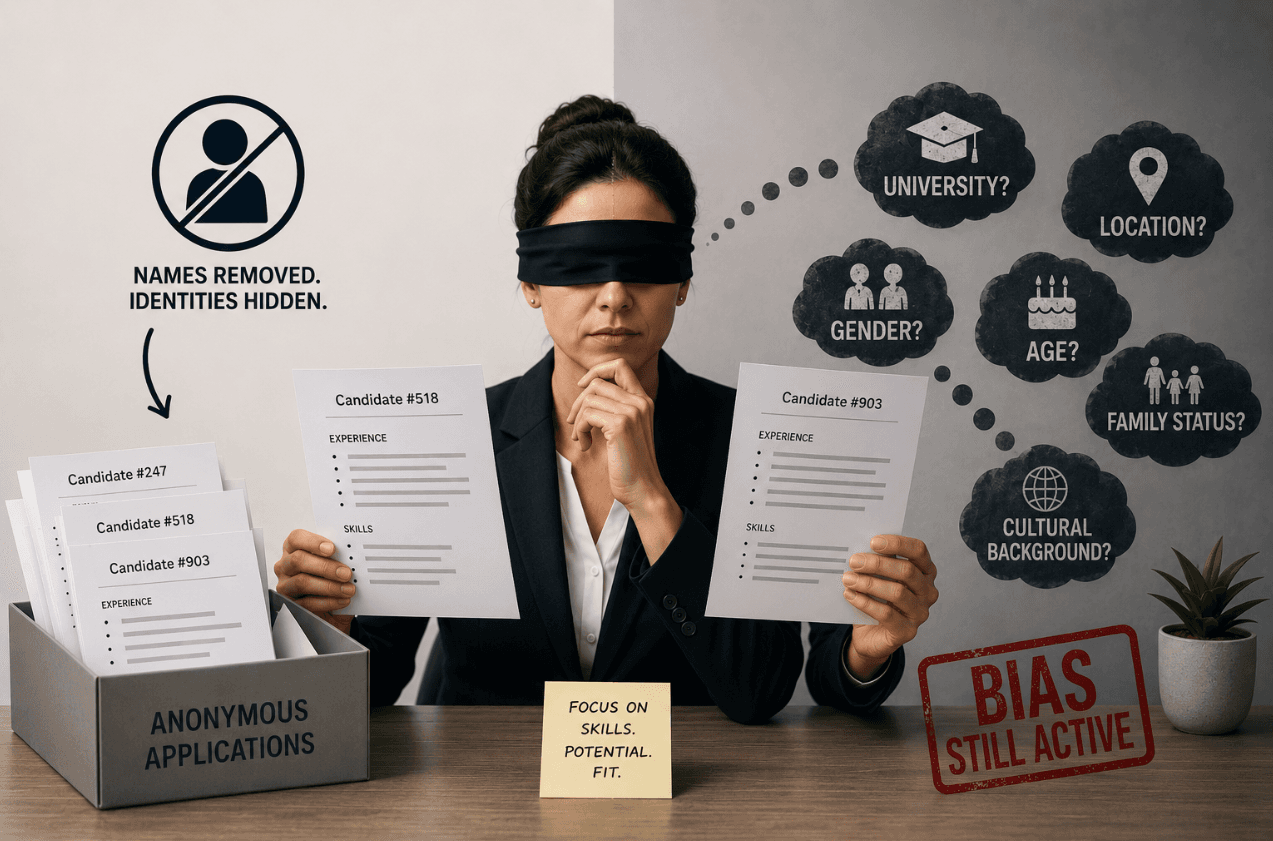
Blind Recruitment: Does Removing Names Really Reduce Bias?
Look, there's something deeply appealing about the promise of blind recruitment. Strip away names, schools, photos - anything that might trigger unconscious bias - and suddenly we're judging candidates purely on merit. Right?
I've been placing finance professionals into Big 4 and FTSE 100 companies for over a decade, and I can tell you the reality is far messier. What started as a well-intentioned experiment has become almost dogmatic in some quarters, despite decidedly mixed results.
The Blind Leading the Blind?
Since the UK government's 2025 push for organisations to publish their bias mitigation strategies, I've watched countless firms rush to implement name-blind recruitment as their quick fix solution. Checkboxes ticked, problem solved!
But here's what most don't realise: removing names doesn't necessarily remove bias - it just shifts it elsewhere.
I placed three senior financial analysts at a major asset management firm in April. All three had gone through the firm's supposedly bias-free screening process. All three were Russell Group graduates. All three had Big 4 experience. Spotting the pattern?
Some biases are baked into requirements so deeply that removing names makes little difference. The problem isn't seeing the name "Patel" or "Williams" - it's what happens when your process still implicitly favours certain backgrounds regardless.

Beyond Tick Boxes: Diversity Recruitment Strategies That Actually Transform UK Workplaces

Master the Virtual Hot Seat: 7 Video Interview Techniques Recruiters Don't Tell You

How to Master 'Tell Me About Yourself' Interview Question: UK Expert Insights
Where Blind Works (Sometimes)
That said, I've seen blind recruitment make genuine differences in specific contexts:
First-pass CV screening
This is where most firms start, and for good reason. When handling high volumes of applications, anonymising personal details forces reviewers to focus on skills and achievements. One investment bank I work with saw a 22% increase in female candidates making it past the first round after implementing blind screening.
But even this isn't foolproof. Experienced recruiters can often infer gender, ethnicity or social background from the pattern of experiences and institutions listed. Oxford, Goldman Sachs, and treasurer of the rowing club? We're painting a picture regardless of whether there's a name attached.
Work sample assessments
Blind evaluation of actual work samples probably has the strongest evidence behind it. When my clients judge financial models, analysis samples, or case studies without names attached, the results tend to be markedly different than when they know who produced the work.
A wealth management firm I've placed several analysts with runs blind technical challenges where candidates analyse a dataset and make investment recommendations. They've found their hiring patterns shifted significantly when reviewers didn't know candidate identities.
The Blind Spots of Blind Recruitment
While the FCA's 2025 inclusive recruitment guidelines heavily promote anonymous applications, they miss crucial nuance about when this approach falls short:
Interview stages are never truly blind
Unless you're conducting text-only interviews (which exactly nobody is doing), bias inevitably creeps back in once you meet candidates. And let's be honest - interview performance matters enormously in hiring decisions.
I had a client who proudly told me about their blind CV process, only to then admit they "just didn't click" with three consecutive female candidates during interviews. What good is your blind process if bias reasserts itself the moment you actually meet people?
Context matters
Sometimes understanding someone's background provides crucial context for their achievements. A candidate who was first in their family to attend university and worked part-time throughout their studies might have a less polished CV than someone from a privileged background - but their journey might demonstrate remarkable grit and potential.
Blind recruitment can inadvertently penalise candidates whose achievements shine brightest when viewed in context.
Making Blind Recruitment Work
So what should you actually do? Based on what I've seen work across dozens of finance firms:
-
Use blind screening for initial CV reviews and work sample evaluations, where it's most effective
-
Train your interviewers properly - blind processes mean nothing if interview bias goes unchecked
-
Standardise your assessment criteria before seeing candidates, not after
-
Look at your requirements - are they unnecessarily filtering out diverse talent?
-
Monitor your outcomes - if your blind process still leads to homogenous hires, it's not working
A major accounting firm I work with combines blind work sample assessment with structured interviews based on pre-defined competencies. They've seen genuine diversity improvements, but crucially, they're honest that blind recruitment alone wasn't enough.
Beyond the Blindfold
I'm not saying abandon blind recruitment entirely. I'm saying recognise its limitations.
The UK's new Equitable Hiring Act has pushed companies to demonstrate "meaningful bias reduction" - but too many are hiding behind performative solutions. Some organisations proudly announce their blind recruitment process while continuing to hire from the same talent pools they always did.
Real change requires examining every stage of your recruitment process, not just removing names from CVs. It means questioning where your candidates come from, how you assess them, and what "fit" really means in your organisation.
Bias doesn't disappear behind a blindfold - especially if you peek.
Browse the latest finance recruitment insights for more strategies beyond blind recruitment. Or explore how The OHub's recruitment platform is helping companies build genuinely inclusive hiring processes through their structured assessment tools.
What's your experience with blind recruitment? Has it changed your hiring patterns, or just changed how you feel about them?


