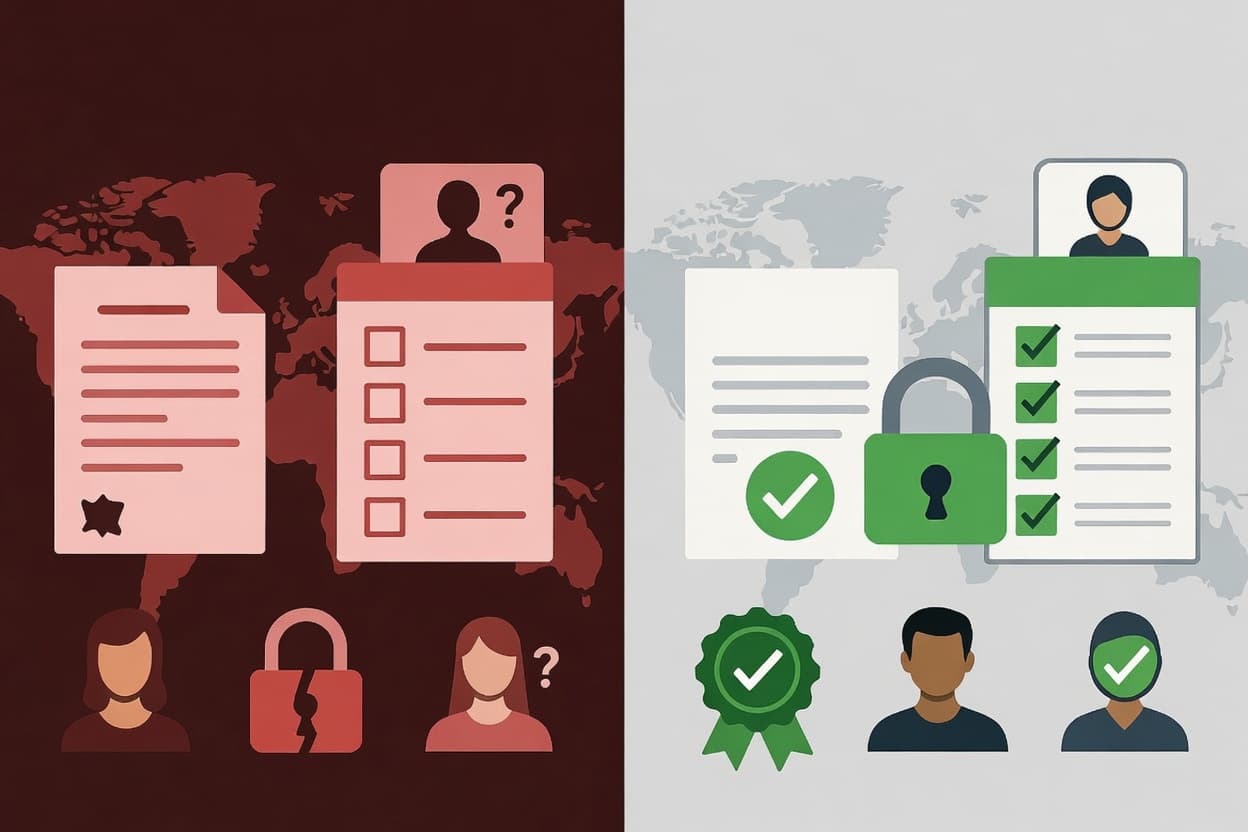
Avoiding the traps of dodgy overseas job offers
The remote work explosion since COVID made us all potential global workers. And while this has been mostly brilliant, I've built fantastic teams across three continents that outperform plenty of in-office ones, it's also created the perfect breeding ground for scammers.
I can't count how many candidates from my Philippines teams have shown me sketchy "job offers" they've received, asking if they look legitimate. Some are laughably bad. Others are sophisticated enough to fool even experienced professionals.
Thing is, the line between "ambitious startup with cash flow issues" and "outright scam" isn't always clear-cut. After building distributed teams for nine years, I've developed a nose for what stinks. The red flags haven't changed much, but the packaging has gotten slicker.
This matters more than ever in 2026. With UK inflation finally settling down but cost pressures still fierce, more companies are genuinely looking abroad for talent. At the same time, sophisticated scammers have gotten better at impersonating legitimate employers.
The five most common remote job scams I see in 2026
Let's get specific. These are the most prevalent scams targeting international candidates right now:
1. The "Pay-to-Play" Setup
This classic never dies. You're offered a dream job, but wait, you need to pay for equipment, training, background checks, visa processing, or some other manufactured expense.
A recruiter from Manila recently showed me a "job offer" from what claimed to be a London fintech. The role looked perfect, until they asked for £350 for "mandatory security compliance software." No legitimate employer charges you to start working for them. Full stop.
2. The Data Harvest
These scams have become depressingly sophisticated. You apply for a reasonable-sounding job, receive promising feedback, and then undergo an extensive application process requiring personal information way beyond what's needed.
The goal? Identity theft or financial fraud. I've seen fake applications asking for passport scans, bank details "for salary processing," and even utility bills, all before any legitimate job offer. Real employers request this information through secure portals and only after making a formal offer.
3. The Commission-Only Mirage
These aren't technically scams, but they're often terrible deals disguised as opportunities. You'll see phrases like "unlimited earning potential" and "be your own boss" while the fine print reveals zero base salary.
The most common version I've seen lately targets people in the Philippines with "international sales roles" promising commissions on products that either don't exist or are impossible to sell. Without a base salary, these aren't jobs, they're gambles, and the house always wins.
4. The Money Mule Trap
This one's potentially criminal. You're hired for a "financial processing" or "payment coordination" role where your primary duty involves receiving money into your personal account and transferring it elsewhere, usually keeping a percentage.
This is money laundering, full stop. I've seen candidates from Eastern Europe targeted heavily with these scams, with the fraudsters impersonating UK financial services firms. If a job primarily involves moving money through your personal accounts, run.
5. The Fake Interview Scam
A recent evolution I've noticed involves fake interviews conducted over messaging platforms rather than video calls. The "interviewer" asks reasonable questions but never shows their face.
The goal is either to extract personal information or, increasingly, to get you to complete "sample work" that's actually real client work they're being paid for. One developer I know was asked to complete a "simple coding test" that turned out to be a client project worth thousands.

Beyond Tick Boxes: Diversity Recruitment Strategies That Actually Transform UK Workplaces

Master the Virtual Hot Seat: 7 Video Interview Techniques Recruiters Don't Tell You

How to Master 'Tell Me About Yourself' Interview Question: UK Expert Insights
The Verification Checklist
Look, I've hired hundreds of people across borders. Here's what I tell candidates to check before engaging with any remote opportunity:
Basic company verification
This should be your starting point. But it's not as simple as "Google the company." Scammers are clever.
-
Check Companies House for UK companies. It's still the gold standard for verifying registered businesses. Note when the company was formed, scammers often use newly created shell companies.
-
Look up their VAT number if provided. UK VAT numbers can be verified through the government's VAT Information Exchange System. Any resistance to providing this is suspicious.
-
Research the specific team or department. Many scammers use legitimate company names but fake departments.
-
Find the hiring manager on LinkedIn. Not just the company, the actual person who'll be your boss. Message current employees (not ones mentioned in the job ad) to verify the role exists.
Communication audit
This is where most scams fall apart if you know what to look for:
-
Insist on video interviews. Scammers avoid showing their faces. If they keep making excuses about camera problems, that's a red flag.
-
Check email domains carefully. "company-uk.com" instead of "company.co.uk" or "company.com" is suspicious. Legitimate large companies rarely use Gmail or Hotmail for official communications.
-
Notice language patterns. Excessive formality, odd grammar, or overly casual communication from supposed multinationals can indicate something's off.
-
Be suspicious of urgency. Scammers push for quick decisions because scrutiny is their enemy.
Financial red lines that should never be crossed
Some boundaries are non-negotiable:
-
Never pay anything upfront. No setup fees, no equipment fees, no training fees. Never.
-
Demand a proper contract before starting work. It should have clear terms, conditions, payment schedules, and be on company letterhead with proper contact details.
-
Be wary of unusual payment methods. Legitimate international companies use payroll providers like Deel, Remote, Oyster, or standard bank transfers, not cryptocurrency, gift cards, money transfer services, or payment apps.
-
Watch for overpayment schemes. If your new "employer" accidentally pays you too much and asks for some back, it's almost certainly a scam.
The vetting gap between UK and international hires
I've noticed a persistent problem when recruiting internationally: UK employers often apply less rigorous vetting processes to overseas contractors than they would to local hires. There's an assumption that due diligence matters less for remote workers.
This works both ways. As candidates, you need to apply the same level of scrutiny to potential employers as they should apply to you.
Ask about:
- Their onboarding process
- How performance is measured
- Communication expectations
- Payment schedules and methods
- Dispute resolution procedures
A legitimate employer should have clear answers to all these questions. If they don't, they're either a scam or so disorganised that working with them will be a nightmare anyway.
Legitimate remote work red flags vs. cultural differences
This is where things get tricky. Some things that might seem like red flags are actually just cultural differences in how business operates.
For example, if you're in the Philippines applying to a UK company, you might find their communication style unusually direct. This isn't a red flag, it's just British workplace culture.
Conversely, UK employers often misinterpret the more relationship-focused communication style from Filipino candidates as being evasive or unclear.
Distinguishing normal workplace variations from true red flags:
Normal variations
- Direct Feedback: UK/European managers often skip pleasantries and offer blunt critiques without offense intended.
- Flat Hierarchy: Fast-paced scale-ups expect candidates to challenge ideas regardless of seniority.
- Asynchronous Pacing: Shifted response times driven by international time differences.
Definite Red Flags
- Pre-Offer Data Harvesting: Requests for passport scans, tax IDs, or banking credentials before a formal contract is executed.
- Evasive Details: Vague job descriptions or interviewers unwilling to explain team structures.
- Unsolicited Messaging Channels: Job offers conducted entirely via Telegram, WhatsApp, or text chat without live video.
- Payment Demands: Any request for the candidate to purchase software, hardware, or "compliance certifications" upfront.
I've learned the hard way that what works in managing a team in London doesn't always translate to Manila or Bucharest. But ethical business practices are universal.
Secure channels for finding legitimate remote work
In my experience, the most reliable channels for finding legitimate remote opportunities vary by country and industry. For the Philippines, I've found the following work consistently well:
- Industry-specific job boards rather than general ones
- LinkedIn direct applications (not unsolicited messages)
- Established remote work platforms with payment protection
- Company career pages accessed directly (not via email links)
Remote work platforms like The OHub that verify employers before listing their jobs significantly reduce your risk of scams. They've done some of the vetting work for you.
Platforms with built-in payment protection are worth their weight in gold. They hold payment in escrow until work is completed, protecting both parties.
Regional Scam Tactics
Having built teams across the Philippines, India, and Eastern Europe, I've noticed that scammers target different regions with tailored approaches.
-
Philippines (Fake UK/US Agency Affiliation): Watch for promises of guaranteed visa sponsorship, claims of "UK government-partnered" roles, or demands for mandatory upfront "compliance training" fees.
-
India & South Asia (Tech Repo & IP Extraction): Be cautious of unpaid "coding challenges" that are actually real client production work, delayed payments during probationary periods, or requests to install unverified software.
-
Eastern Europe (Financial Processing / Money Mule): Beware of roles disguised as "payment coordination," vague crypto-settlement tasks, or any request to handle fund transfers through your personal accounts.
What to do if you've been scammed
It happens to smart people. If you've fallen victim:
- Stop all communication immediately
- Document everything (screenshots, emails, messages)
- Report to local authorities and cybercrime units
- Alert your bank if you've shared financial details
- Change passwords for any accounts you've shared information about
- Report the scam to the job platform where you found it
In the UK, report to Action Fraud. Most countries have equivalent cybercrime reporting systems.
The employer perspective
As someone who's built international teams for UK companies, I should mention that legitimate employers are equally frustrated by scams. They create distrust that makes genuine recruiting harder.
Legitimate employers should:
- Provide clear company verification information upfront
- Use secure, professional communication channels
- Follow a structured interview process
- Send formal contracts before starting work
- Have clear payment processes through established channels
- Never request payments from candidates
If you're a candidate and your potential employer isn't doing these things, ask why not. Their response will tell you a lot.
Final thoughts: Trust your gut
After placing hundreds of international candidates, I've learned that intuition matters. If something feels off, it probably is.
The jobs market in 2026 is competitive but not desperate. Legitimate remote opportunities exist in abundance for qualified candidates. You don't need to take risks with suspicious offers.
The most successful international candidates I've placed share one trait: they approach job hunting with healthy skepticism. They verify before trusting. They ask questions. They're willing to walk away from opportunities that don't feel right.
In the remote work gold rush, it's worth remembering that not all that glitters is gold. Sometimes it's just a scammer with a fancy website and promises they never intend to keep.
But with proper verification steps and a critical eye, you can find genuine opportunities that actually deliver on their promises. I've seen it happen hundreds of times. The good employers are out there, they're just sometimes hidden behind a wall of scams you need to filter through first.
Use these guidelines, trust your instincts, and remember that legitimate employers want to verify that you're real just as much as you want to verify that they are. The verification process should always be mutual.
If an opportunity seems too good to be true, it probably is. But that doesn't mean there aren't great opportunities out there. They just rarely arrive in unsolicited WhatsApp messages promising the moon.