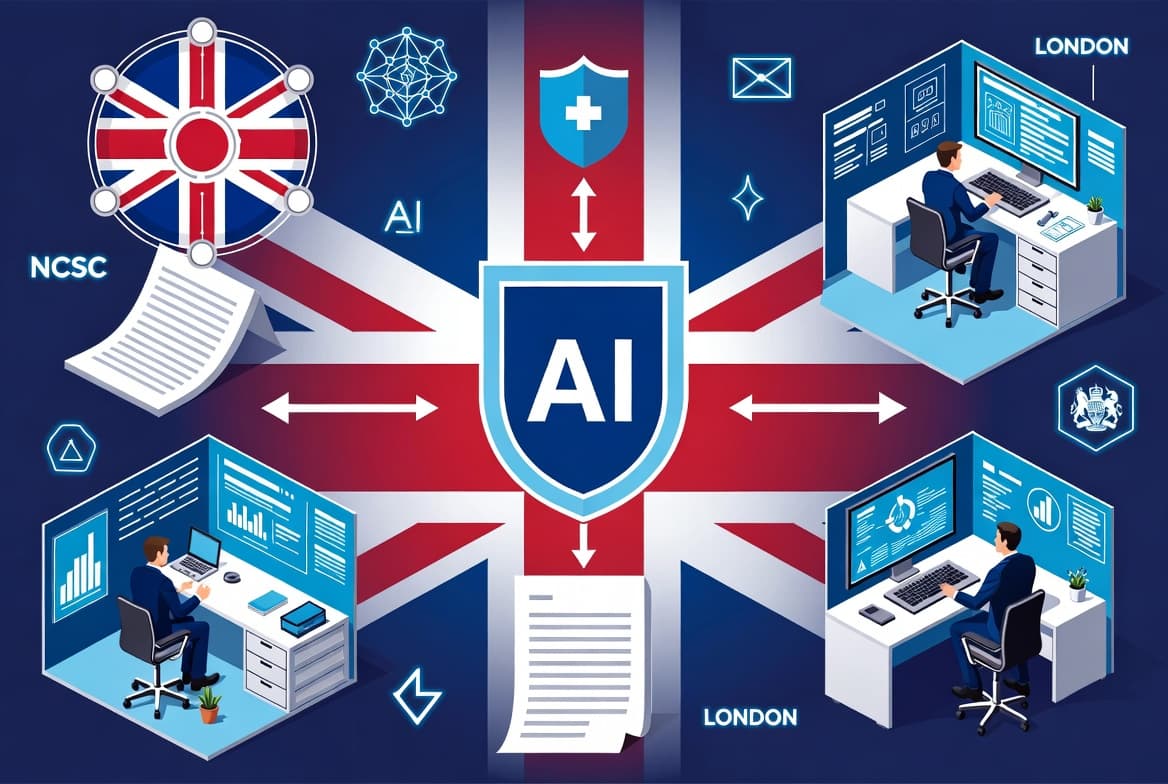
I've seen recruitment trends come and go, but the scramble to hire AI security specialists right now is something else entirely. It's July 2026, and I'm watching organisations trip over themselves trying to fill roles that barely existed 18 months ago.
The catalyst has been a combination of the NCSC's ongoing AI security guidance, the ICO's automated decision-making guidance, and the broader pressure from the EU AI Act's extraterritorial reach on UK firms with EU exposure. They've sparked nothing short of a hiring revolution in sectors where data sensitivity meets algorithmic complexity.
The guidelines themselves weren't particularly surprising - the writing had been on the wall since the disastrous public sector AI incidents of 2024-25. But the specificity of the controls, and especially the accountability requirements, caught plenty of firms with their trousers down.
The New Hybrid Role That's Breaking My LinkedIn
What's fascinating is watching how job specifications have evolved in real time. Traditional security roles are morphing before our eyes.
I placed a Head of Security at a mid-sized fintech last month. Three years ago, that role wouldn't have mentioned AI governance at all. Today? Nearly 40% of the job spec focused specifically on establishing controls around their machine learning operations.
This isn't just happening in finance. Healthcare, legal tech, public sector - they're all scrambling to find the same unicorns. People who understand both security architecture AND machine learning governance frameworks.
Some clients are solving this by creating entirely new roles. Others are grafting AI security responsibilities onto existing security functions. Neither approach is working particularly well, if I'm honest.
Salary Implications - Brace Yourselves
The compensation picture is predictably chaotic. I'm seeing eye-watering salary inflation for candidates who can genuinely bridge both worlds.
A qualified security architect with NCSC AI certification experience in London? You're looking at £120-150K base minimum. Add in bonuses and equity, and you're easily pushing £200K+ for top talent. Mid-level security analysts with AI validation experience are commanding £85-95K, up from the £65-75K range we saw just 18 months ago.
But this isn't sustainable. The pool of candidates who deeply understand both domains remains tiny. Many organisations are being forced to build hybrid teams rather than find hybrid individuals.

Beyond Tick Boxes: Diversity Recruitment Strategies That Actually Transform UK Workplaces

Master the Virtual Hot Seat: 7 Video Interview Techniques Recruiters Don't Tell You

How to Master 'Tell Me About Yourself' Interview Question: UK Expert Insights
What The NCSC Framework Actually Demands
It's worth unpacking what the NCSC guidelines actually require, because I'm still meeting plenty of hiring managers who haven't properly digested them.
The framework centres on five core domains:
- Supply chain security for AI components
- Validation protocols for model integrity
- Runtime protection mechanisms
- Data provenance and lineage tracking
- Security monitoring specifically adapted for AI systems
What's not obvious from a casual reading: the certification process demands documented evidence of competency across all these domains. You can't just tick boxes. The assessors want to see evidence of integrated security thinking.
And that's the challenge. Most security professionals I work with have depth in domains 1, 3, and 5. Almost none have meaningful experience in domains 2 and 4 without some AI background.
The Certification Gold Rush
I've had clients ask me about AI security certifications almost daily. The most significant launch in this space in 2026 has been CompTIA's SecAI+ (launched February 17, 2026), the first vendor-neutral certification specifically covering AI security, AI-assisted security operations, and AI governance frameworks. Is it worth getting? Absolutely. Is it enough? Not by itself.
The most successful candidates I've placed have combined the certification with demonstrable project experience. The certification gets you in the door, but it's the war stories that seal the deal.
That said, the certification isn't trivial to obtain. CompTIA SecAI+ was launched too recently for published pass rate data to be available. What I'm seeing anecdotally is that candidates with pure security backgrounds who underestimate the AI governance components are finding it harder than expected.
Where To Find These Unicorns
If you're a hiring manager desperate for this hybrid talent, I've got bad news. You're unlikely to find a ready-made solution walking through your door.
The organisations succeeding in this space are doing three things:
- Pairing security specialists with AI specialists in collaborative teams
- Investing heavily in upskilling their existing security teams
- Creating clear career pathways that value both domains equally
I've seen internal mobility become the secret weapon for several clients. Taking AI engineers with security interest, or security engineers with AI curiosity, and giving them structured development plans.
The most frustrating conversations I have are with companies expecting to hire a complete solution. These roles are evolving too rapidly for that approach to work.
Beyond Compliance - Where This Is Really Headed
The smartest organisations I work with aren't just hiring for NCSC compliance. They recognise these guidelines represent the beginning, not the end, of AI security requirements.
The truly forward-thinking firms are building security-by-design principles into their AI development lifecycles. They're not treating security as a separate function that validates AI work - they're integrating security thinking from day one.
This has massive implications for hiring. The siloed approach to security and AI talent acquisition simply won't cut it anymore.
Will the talent gap close soon? Not likely. Universities are racing to develop hybrid security and AI programmes, but we're years away from seeing graduates with this combined skillset hit the market at scale.
In the meantime, if you're hiring in this space, my advice is simple: look for learning agility over complete technical mastery. Someone who deeply understands security fundamentals and is actively building AI knowledge will outperform a security veteran who's resistant to learning new domains.
And if you're a security professional looking to remain relevant? Get your hands on that NCSC certification. Now.
The integration of AI and security was always inevitable. Current guidance has accelerated the timeline. Adapt now.
Amara Okafor is a fintech recruitment specialist placing software engineers and product managers at London's hottest startups.


