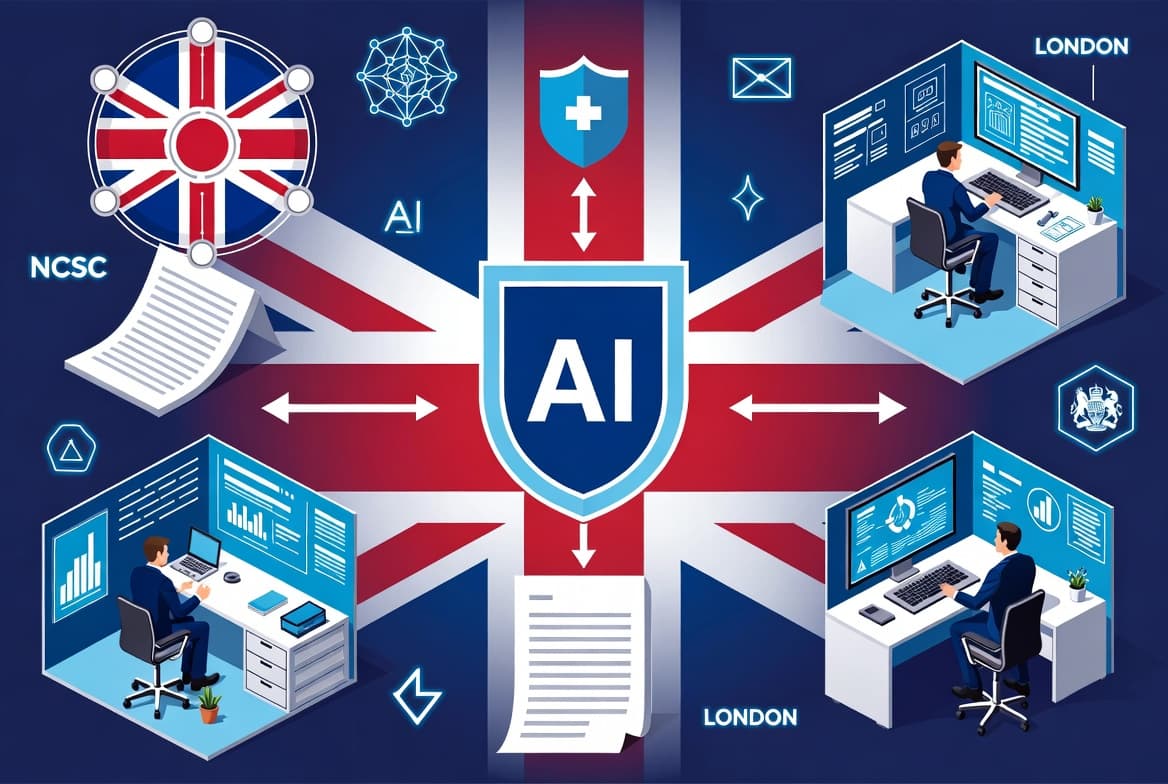
AI and Cyber Hiring in 2026: The Crossover Roles Every Firm Needs
When I placed my first AI security engineer last month, the salary made my jaw drop. £220,000 base with a £75,000 bonus potential and significant equity. Not for a FAANG giant, mind you, but a Series B fintech with only 120 employees.
Welcome to the 2026 reality: the war for AI cybersecurity talent has reached fever pitch, and the battleground has fundamentally changed.
The traditional boundaries between AI engineering and cybersecurity have completely dissolved. If your company still maintains these as separate departments with separate hiring pipelines, you're already behind.
The Great Convergence: Why AI and Security Can No Longer Be Separated
The statistics are staggering. A growing proportion of security breaches now involve compromised AI systems. Yet only 22% of UK companies have dedicated AI security specialists on staff.
This gap exists because most organisations still operate with an outdated model:
- AI engineers build sophisticated systems with limited security knowledge
- Security teams try to protect these systems with limited AI expertise
- Neither team speaks the other's language fluently
This problem has intensified dramatically as AI systems have become more prevalent in enterprise environments. Traditional security professionals often don't understand the unique vulnerabilities of foundation models, while many AI engineers lack the adversarial mindset needed for robust protection.
The New Hybrid Roles Reshaping Tech Teams
1. AI Red Teamers
These specialists combine offensive security expertise with deep LLM knowledge to systematically attack AI systems, identifying vulnerabilities before malicious actors can exploit them.
Key responsibilities:
- Conducting adversarial prompt injection attacks against production LLMs
- Developing novel jailbreaking techniques to test containment measures
- Simulating sophisticated model extraction and poisoning attempts
- Creating comprehensive remediation roadmaps
Hiring difficulty: Extreme (average time-to-fill: 4.3 months)
Salary range: £150,000-£240,000 (London)

Beyond Tick Boxes: Diversity Recruitment Strategies That Actually Transform UK Workplaces

Master the Virtual Hot Seat: 7 Video Interview Techniques Recruiters Don't Tell You

How to Master 'Tell Me About Yourself' Interview Question: UK Expert Insights
2. Secure ML Engineers
These professionals build machine learning systems with security embedded throughout the development lifecycle, not bolted on afterwards.
Key responsibilities:
- Implementing privacy-preserving machine learning techniques
- Developing robust model validation frameworks
- Creating secure data pipelines resistant to poisoning
- Designing architecture for secure model deployment
Hiring difficulty: High (average time-to-fill: 3.2 months)
Salary range: £110,000-£175,000 (London)
3. LLM Safety Researchers
Focused on alignment and safety, these specialists ensure large language models behave according to human values and don't pose catastrophic risks.
Key responsibilities:
- Developing and implementing alignment techniques
- Creating safety monitoring systems for production LLMs
- Conducting factuality and harmful output evaluations
- Collaborating with ethics teams on responsible AI deployment
Hiring difficulty: Very high (average time-to-fill: 3.8 months)
Salary range: £125,000-£190,000 (London)
4. AI Security Compliance Specialists
With the EU AI Act fully implemented and the UK's evolving AI governance framework creating new compliance requirements, these experts navigate the complex regulatory landscape.
Key responsibilities:
- Ensuring AI systems meet regulatory requirements across jurisdictions
- Developing transparent documentation for high-risk AI systems
- Managing security audit preparations and remediation
- Creating governance frameworks for secure AI development
Hiring difficulty: Moderate (average time-to-fill: 2.5 months)
Salary range: £90,000-£140,000 (London)
How to Build Your Hybrid AI Security Team
Assessment:
Identify Your Current Gaps
Start by evaluating your current capabilities. Most organisations fall into one of three categories:
- AI-Strong/Security-Weak: Sophisticated AI capabilities but limited security integration
- Security-Strong/AI-Weak: Robust security practices but minimal AI-specific protections
- Fragmented Expertise: Pockets of both skills but no cohesive strategy
The OHub's talent assessment framework can help identify exactly where your gaps lie, comparing your team against industry benchmarks.
Recruitment:
Beyond Traditional Hiring Channels
Forgetting traditional job boards is step one. These hybrid specialists rarely respond to conventional outreach.
Where to find AI security talent in 2026:
- Specialist AI safety communities: The UK AI Safety Network and MATS alumni are gold mines
- Capture-the-flag competitions: LLM CTF events like HackLLM have become premier recruiting grounds
- Academic partnerships: Imperial College's AI Security Lab and Edinburgh's Safety Centre produce top talent
- Security professionals with AI side projects: Look for cybersecurity experts who contribute to open-source LLM projects
Video-first recruitment approaches have proven particularly effective for these roles, allowing candidates to demonstrate their technical thinking rather than just listing credentials.
Retention:
The Hidden Challenge
Hiring is only half the battle. With average tenure for AI security specialists now just 14 months, retention requires strategic thinking.
Effective retention strategies for 2026:
- Research time allocation: 20% dedicated time for exploring novel security approaches
- Conference participation: Budget for international AI safety conferences (now £8,000-£12,000 annually per specialist)
- Tool investment: Access to premium AI security platforms (average spend: £35,000-£50,000 per specialist)
- Continuing education: Dedicated learning budgets for emerging threat vectors (£15,000+ annually)
Companies with the highest retention rates provide all four elements, according to recent research.
Building vs.
Training: The Make-or-Buy Decision
Faced with a severe talent shortage, many organisations are creating their own hybrid specialists through intensive upskilling programs.
The most successful approach I've seen combines:
- Identifying high-potential security professionals with strong analytical abilities
- Pairing them with AI engineers in collaborative projects
- Providing structured training in both domains
- Creating clear career progression paths
Forward-thinking organisations that invest in internal AI security training programmes are seeing strong results, producing qualified AI security engineers from their existing talent pool while significantly reducing both recruitment costs and incident response times.
The Path Forward: Integration is Non-Negotiable
The companies winning the AI security talent war in 2026 share one common characteristic: they've rejected the siloed approach entirely.
Rather than separate AI and security teams that occasionally collaborate, they've created unified departments where these disciplines are fully integrated. This structural change sends a powerful signal to potential hires about how seriously the organisation takes this convergence.
Premium recruitment partners with expertise in both domains can help architect these integrated teams, ensuring the right balance of skills and perspectives.
Conclusion:
Act Now or Fall Behind
The demand for AI security crossover talent will only intensify as AI systems become more powerful and more deeply embedded in critical infrastructure. Companies that wait until they experience a serious AI security incident will find themselves competing for talent in an even more challenging market.
If you're responsible for securing your organisation's AI future, the time to build your hybrid team is now. The costs are significant, but the alternative, as recent high-profile AI security breaches have demonstrated, can be existential.
Want to discuss your specific AI security talent needs? Explore specialised recruitment solutions or connect with me on The OHub for personalised guidance.