I've spent almost a decade building teams across Manila, Mumbai, Kyiv and Warsaw, and if there's one mistake I see repeated across nearly every new remote setup, it's quality control that swings between two extremes: micromanagement that crushes morale or a hands-off approach that lets standards slip until someone important notices.
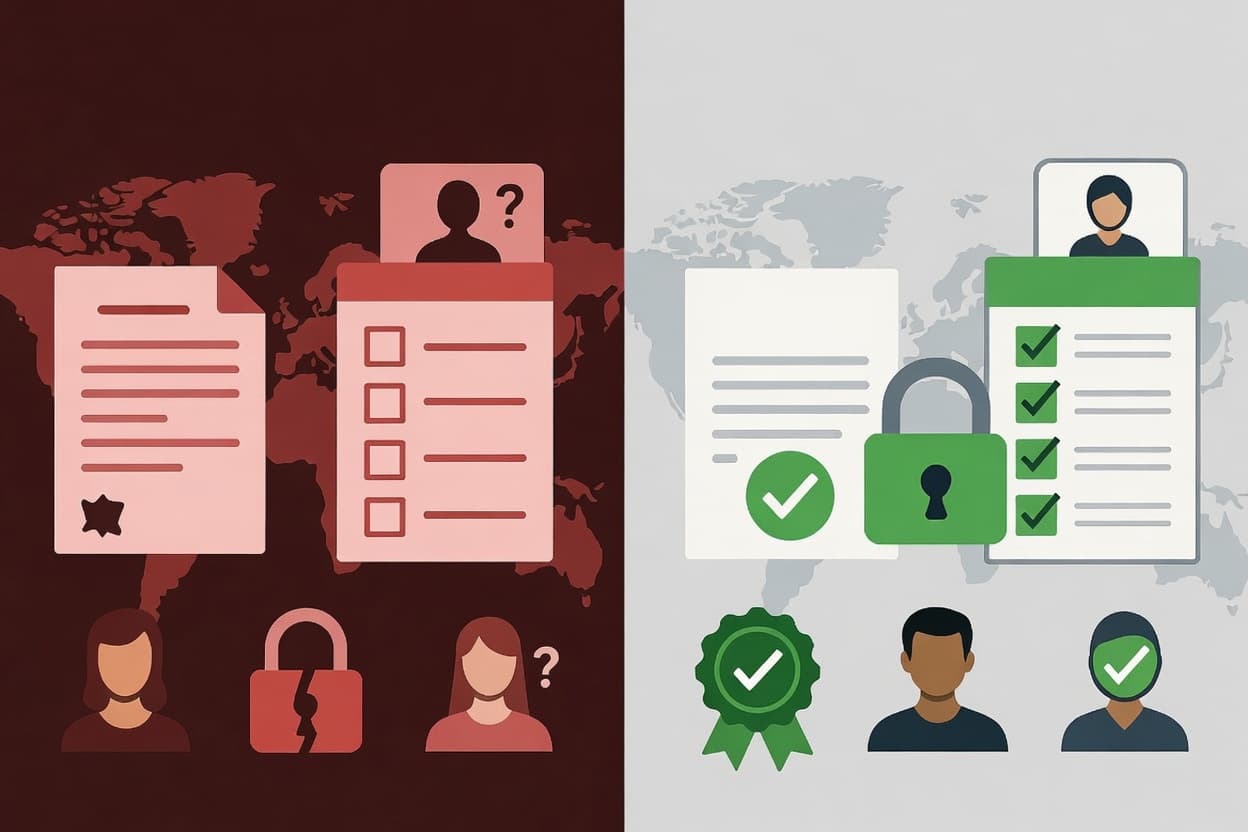
Both approaches fail spectacularly. Neither acknowledges the reality that remote quality control isn't about finding mistakes - it's about building systems where mistakes become increasingly rare.
The Trust Paradox
Something weird happens when you can't physically see your team. Even rational managers start doubting output quality. I've watched companies implement daily status reports, screenshots every 15 minutes, and mandatory video-on policies for eight straight hours. These companies rarely have offshore teams 12 months later.
Yet the completely hands-off approach - "we hired professionals, they'll figure it out" - inevitably leads to misalignment, hidden problems, and eventual finger-pointing.
The sweet spot exists, but it takes intentional design.

Beyond Tick Boxes: Diversity Recruitment Strategies That Actually Transform UK Workplaces

Master the Virtual Hot Seat: 7 Video Interview Techniques Recruiters Don't Tell You

How to Master 'Tell Me About Yourself' Interview Question: UK Expert Insights
Quality By Design, Not Inspection
After running distributed development teams across three continents, I've come to believe quality cannot be inspected into a process. It must be built into the workflow itself.
What does this mean practically? Let me break it down:
1. Define done in excruciating detail
Vague requirements produce inconsistent results. My Manila development team initially struggled with frontend quality until we built acceptance criteria checklists for every task type. These weren't generic "must look good" standards but specific items like:
- Has been tested across standard viewports (390px mobile, 768px tablet, 1280px, and 1920px desktop)
- All form fields display real-time validation and localized error states
- Largest Contentful Paint (LCP) stays under 1.8 seconds on 4G-throttled network tests
By 2026 standards, explicit performance budgets like these should be baseline. Yet, so many companies still send offshore teams vague requirements like "make it fast and responsive," then express shock when deliverables miss unwritten expectations.
2. Calibration sessions beat after-the-fact reviews
The best quality control happens before work starts. Rather than exhaustive reviews of completed work, we now run bi-weekly calibration sessions with our offshore teams.
These 30-minute video calls focus on reviewing recent deliverables that represent either excellent work or common issues. The goal isn't punishment but alignment. "Here's what great looks like" is infinitely more effective than "this isn't good enough."
3. Automated QA catches the obvious stuff
Make machines do what machines do best. My Philippine content team uses custom AI brand-voice guardrails, automated plagiarism/AI-pattern scanners, and semantic checkers that flag style drift, sentence complexity, and readability issues before human eyes ever see a draft. On the engineering side, automated CI/CD pipelines run static code analysis, security scans, and visual regression tests on every pull request.
These automated guardrails catch roughly 80% to 85% of surface-level errors, freeing review time for what actually matters: strategic alignment, context, and creative edge, rather than catching typos or linting bugs.
4. Peer review beats manager review
The best quality control system I've ever implemented was simple: nobody's work goes to the client until a teammate reviews it first. This applies to code, content, designs - everything.
With teams in Cebu City, we initially faced resistance. Team members worried about appearing critical of colleagues or being judged for their own mistakes. The breakthrough came when we reframed peer review as a collective quality responsibility rather than individual criticism.
This works especially well when the offshore team has varying experience levels. Senior team members naturally mentor juniors through the review process.
The Rhythm Method for Quality Control
No, not that rhythm method. I'm talking about establishing predictable quality touchpoints that become the heartbeat of your distributed work:
- Daily: Automated checks run on all deliverables
- Weekly: Peer reviews complete before client handoff
- Bi-weekly: Calibration sessions review quality standards
- Monthly: Process retrospective to identify systemic issues
When quality becomes rhythmic rather than reactive, it stops feeling like surveillance and starts feeling like support.
The vital feedback loop
What happens after quality issues surface makes all the difference. My Eastern European development team transformed their output after we implemented a simple rule: every substantive feedback item must result in a documented process improvement.
If the same error happens twice, it's not the individual's problem - it's the system's problem.
This shifted the culture from "avoid mistakes" to "improve the system." The impact on quality was immediate and sustainable.
Red Flags: When Your QA Process Is Broken
How do you know if your quality process needs a rethink? Watch for these warning signs:
- Offshore team members hide mistakes rather than flagging them early
- Quality checks create bottlenecks with work sitting idle awaiting review
- Team seems demoralized by the review process
- The same issues keep recurring despite feedback
- Clients spot problems your internal process missed
Any of these symptoms suggests your quality approach needs surgery, not bandaids.
Real Results Without the Overhead
The best offshore QA systems I've built have increased quality while decreasing management overhead.
Our Manila-based customer support team drove their CSAT from 87% to 96% in under six months after we implemented peer reviews, structured calibration sessions, and automated QA sampling. Even better, the weekly oversight time required from executive management dropped from 15 hours down to just 2 hours.
Quality went up. Oversight went down. Team confidence improved. Client satisfaction increased.
Nothing makes me more frustrated than watching companies fail with offshore teams not because the talent wasn't there, but because they built quality processes that valued control over improvement.
Truth is, if you're still manually checking every piece of work your offshore team produces, you haven't built a scalable system - you've just created a very expensive, time-delayed in-house team with timezone complications.
The future belongs to companies that build offshore quality systems focused on continuous improvement rather than constant inspection. Those that get this right aren't just saving money - they're building truly distributed capability that scales.
And that's the whole point of going offshore in the first place, isn't it?
You can explore more insights on building effective offshore teams or find specialist offshore talent for your next project.