Most UK recruitment teams track basic volume metrics but can't answer the simplest questions about their own data. LinkedIn's research shows organisations using skills data to find talent are 60% more likely to make a successful hire than those that don't. I've witnessed this transformation firsthand while placing senior developers across London's fintech scene, the difference between data-rich and data-poor recruiting is stunning. As someone who's placed over 200 software engineers at UK startups, I can tell you the most successful recruitment teams I work with aren't just collecting data, they're weaponising it. They're identifying hidden talent pools, predicting candidate success, and optimising their entire talent acquisition funnel. While your competitors rely on gut feelings and outdated hiring metrics, I'm about to show you how sophisticated recruitment analytics can transform every aspect of your hiring process.
The £85,000 Problem: Why Traditional Recruitment Metrics Fail
The average cost of a bad hire in the UK tech sector? £85,000, according to research from the Recruitment & Employment Confederation. That figure doesn't just represent wasted salary, it includes onboarding costs, lost productivity, team disruption, and eventual replacement expenses. The painful truth is that traditional recruitment metrics are failing modern hiring teams. Here's why:
- Lagging indicators dominate, Time-to-hire and cost-per-hire tell you what happened, not what will happen
- Surface-level metrics, Most teams track basic volume metrics (applications, interviews, offers) without analysing the relationships between them
- Disconnected data silos, Recruitment data exists in multiple systems with no unified analysis
- Confusion between correlation and causation, Misidentifying what actually drives hiring success
A Head of Talent Acquisition at a leading UK digital bank told me recently that despite tracking dozens of recruitment metrics, they couldn't answer the simplest question: which sourcing channels produce their highest-performing hires?

Beyond Tick Boxes: Diversity Recruitment Strategies That Actually Transform UK Workplaces

Master the Virtual Hot Seat: 7 Video Interview Techniques Recruiters Don't Tell You

How to Master 'Tell Me About Yourself' Interview Question: UK Expert Insights
The Data-Driven Revolution: Beyond Basic Metrics
Advanced recruitment analytics means tracking smarter metrics, not more of them. Forward-thinking talent teams are moving beyond basic measurements to predictive and prescriptive analytics.
The Recruitment Analytics Maturity Model
- Descriptive Analytics (Basic), What happened?
- Time-to-hire, cost-per-hire, source of hire
- Useful but limited to historical perspective
- Time-to-hire, cost-per-hire, source of hire
- Diagnostic Analytics (Intermediate), Why did it happen?
- Conversion rates between hiring stages
- Correlation between candidate attributes and interview success
- Attribution modelling for sourcing channels
- Predictive Analytics (Advanced), What will happen?
- Forecasting hiring needs based on business growth and attrition patterns
- Predicting candidate success likelihood based on historical patterns
- Identifying flight risks in current talent pool
- Prescriptive Analytics (Expert), How can we make it happen?
- Automated candidate sourcing based on success patterns
- Dynamic adjustment of job requirements based on market availability
- AI-powered interview question selection based on role-specific success factors
Top UK tech companies are now operating at levels 3 and 4, while most organisations remain stuck at level 1. The competitive advantage is enormous.
Five Advanced Recruitment Analytics Approaches That Deliver Results
1. Sourcing Channel Effectiveness Analysis
Stop measuring sourcing channels by volume alone. Advanced analytics requires correlating channels with quality metrics:
- Candidate quality score, Create a composite metric from technical assessment scores, cultural fit ratings, and interview feedback
- Channel quality index, Calculate the average candidate quality score by channel
- Quality-adjusted cost per application, Divide channel cost by the number of quality applicants (not just total applicants)
- Long-term performance tracking, Connect sourcing data to performance reviews 6-12 months post-hire
Case study: Companies that implement channel quality analysis often discover their employee referral programmes produce candidates who are far more likely to pass technical assessments than job board applicants, despite generating fewer CVs. By reallocating budget from job boards to referral bonuses, these firms typically increase quality hires while reducing overall recruitment spend. View more about optimising your sourcing channels on The OHub's employer solutions, where talent analytics tools can help identify your most effective recruitment channels.
2. Predictive Success Modelling
Predictive analytics allows you to identify which candidate attributes genuinely correlate with on-the-job success. To build your predictive model:
- Define success metrics, What constitutes a successful hire after 6, 12, and 24 months?
- Gather historical data, Collect assessment scores, interview ratings, CV details, and on-the-job performance data
- Identify correlations, Use regression analysis to find which pre-hire factors correlate with post-hire success
- Build and test your model, Create a scoring system and validate against new hires
McKinsey's research on talent management consistently shows top-quartile companies on hiring practices generate 40% higher revenues per employee than bottom-quartile peers. The gap between data-driven and intuition-driven recruitment isn't marginal.
Implementation tip: Start with one critical role and build a simple model. For software engineering roles, I've found that structured problem-solving tests are 2.7x more predictive of success than years of experience or specific language knowledge.
3. Bias Identification and Elimination
Advanced analytics can reveal hidden biases in your recruitment process that may be filtering out top talent:
- Stage progression analysis, Track conversion rates between stages by demographic groups
- Language sentiment analysis, Use NLP tools to identify potentially biased language in job descriptions
- Interviewer consistency scoring, Measure whether interviewers show rating patterns correlated with candidate demographics
- Decision driver analysis, Identify which factors most influence hiring decisions and whether they're genuinely job-relevant
Example: One UK tech company used analytics to identify a significant drop-off rate for female candidates specifically between CV screening and technical interview stages. Investigation revealed their technical challenge contained unnecessary gaming references that created implicit bias. After revision, female candidate progression improved meaningfully without lowering the bar. The OHub's diversity hiring solutions provide additional tools to identify and address bias in your recruitment processes.
4. Candidate Experience Analytics
According to CareerArc's candidate experience research, 72% of candidates who had a positive experience share it online or with their network, while 65% who had a negative experience share that too. Advanced candidate experience analytics include:
- Sentiment analysis of candidate communications
- Engagement metrics across application stages
- Drop-off analysis to identify friction points
- Net Promoter Score (NPS) surveys at key touchpoints
- Correlation between experience scores and offer acceptance rates
Real-world application: One well-known fintech discovered their technical assessment was causing a high abandonment rate. Their analytics showed that candidates spent far longer on the assessment than the estimated time. By redesigning the assessment to better match the advertised time commitment, they reduced drop-offs significantly and improved their employer review ratings.
5. Integrated Performance and Hiring Analytics
The most sophisticated talent analytics teams connect pre-hire data with post-hire performance:
- Hiring attribute correlation, Which candidate attributes predict performance and retention?
- Interviewer effectiveness, Which interviewers' assessments most accurately predict future performance?
- Assessment validation, How well do technical assessments predict actual technical ability?
- Time-to-productivity tracking, Which hiring sources produce candidates who ramp up fastest?
Case study: A London fintech client discovered their challenging algorithm test was filtering out candidates who would have become top performers. Their data showed no correlation between test performance and actual coding quality 12 months later. By replacing it with a more job-relevant assessment, they widened their talent pool by 34% and improved retention rates.
Implementing Advanced Recruitment Analytics: Your 90-Day Plan
Ready to transform your recruitment with data? Here's your implementation roadmap:
Days 1-30: Foundation
- Audit your data sources, Identify where your recruitment data lives and how accessible it is
- Define your key metrics, Establish which metrics matter most for your specific business goals
- Set up data collection, Ensure you're capturing the right data at each recruitment stage
- Create your data dictionary, Define each metric consistently across teams
Days 31-60: Analysis
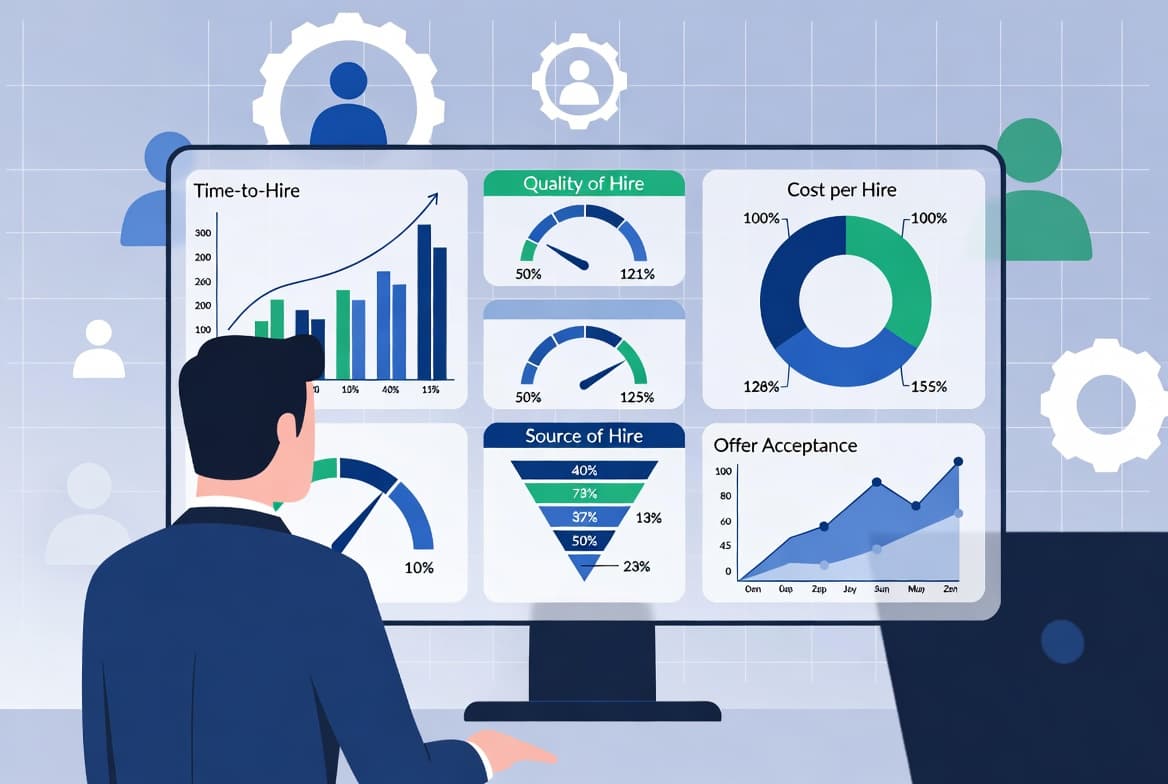
- Build your dashboard, Create visualisations that highlight key insights and trends
- Establish benchmarks, Determine what "good" looks like for each key metric
- Run your first deep-dive analysis, Focus on one critical area (e.g., sourcing effectiveness)
- Share initial insights, Get feedback from stakeholders to refine your approach
Days 61-90: Action
- Develop data-driven interventions, Create specific actions based on your analysis
- Implement A/B testing, Test different approaches and measure results
- Create feedback loops, Establish systems to continuously gather and incorporate new data
- Build your predictive model, Begin forecasting future hiring needs and outcomes
The Future of Recruitment Analytics: What's Next?
As we look ahead, several emerging trends will reshape recruitment analytics:
- AI-powered talent matching, Algorithms that identify ideal candidates based on complex success patterns, not just keywords
- Predictive retention modelling, Identifying flight risks before they arise
- Skills gap analysis, Using market data to predict emerging skill needs
- Talent marketplace efficiency, Optimising internal mobility through skills analytics
- Continuous listening analytics, Real-time sentiment analysis throughout the employee lifecycle
For a deeper dive into these emerging trends, check out The OHub's recruitment insights, which regularly publishes forward-looking research on recruitment analytics.
Transformation Through Data: From Intuition to Intelligence
The recruitment industry is undergoing a fundamental shift, from an intuition-driven art to a data-powered science. The winners in this new era will be those who can effectively harness the predictive power of their data. Based on my experience placing senior tech talent, I've seen firsthand how data-driven organisations consistently outperform their peers:
The organisations that measure well hire faster, spend less per quality candidate, retain employees longer, and build more diverse teams. The specific gains vary by sector and starting point, but the direction is consistent across every study I've seen. For high-volume recruitment needs, consider exploring The OHub's premium headhunting services, which incorporate advanced analytics into their talent search methodology.
Take Action Now: Your Data-Driven Recruitment Roadmap
Ready to transform your hiring with recruitment analytics? Start here:
- Conduct your recruitment analytics audit, Where are you on the maturity model? What data are you already collecting but not using?
- Identify your critical metrics, Choose 3-5 metrics that directly impact your business outcomes
- Connect your data sources, Break down silos between your ATS, HRIS, and performance management systems
- Build your talent intelligence capabilities, Upskill your team on data analysis and visualisation
- Start small, scale fast, Begin with one high-impact analysis, demonstrate ROI, then expand
Remember, the goal isn't perfect data, it's better decisions. Even incomplete data, properly analysed, is vastly superior to gut feelings alone. Recruiters who can turn their data into decisions will outperform those who can't.
Amara Okafor is a fintech recruitment specialist with over 8 years of experience placing software engineers and product managers at London's leading startups. She specialises in data-driven hiring strategies and technical recruitment optimisation.